Buying Oligo Hyaluronic Acid for international production requires more than comparing prices. Buyers must examine molecular weight, purity, moisture content, source, documentation, and supplier consistency. A bright powder sample may look acceptable, yet its certificate may reveal weak testing or unclear specifications. Details matter.
Dr. Endre A. Balazs, a pioneering hyaluronan researcher, described hyaluronic acid as “one of nature’s most versatile molecules.” That versatility creates both opportunity and confusion. Oligo Hyaluronic Acid can support cosmetic, healthcare, and research applications, but each use requires careful technical evaluation. A low molecular weight claim should never replace verified laboratory data.
This guide presents seven practical buying tips for global buyers. It focuses on specifications, batch traceability, analytical methods, manufacturing controls, packaging, logistics, and supplier communication. Ask for a current certificate of analysis. Check whether the reported molecular weight matches your formulation needs. Confirm the test method, not only the final number. Small gaps become expensive later.
Experience also teaches humility. Even experienced purchasers can overlook stability during transport or misunderstand “high purity” language. Not every supplier provides the same evidence. Some documents need closer review. Some questions feel obvious, but they prevent costly mistakes.
Reliable sourcing is a process. It involves technical judgment, documented evidence, and honest discussion with manufacturers. Buyers should assess product quality and supplier reliability together. The cheapest quotation may not be the safest commercial decision. A transparent supplier will explain limitations, testing frequency, storage conditions, and realistic lead times. That clarity builds confidence before the first order is placed.
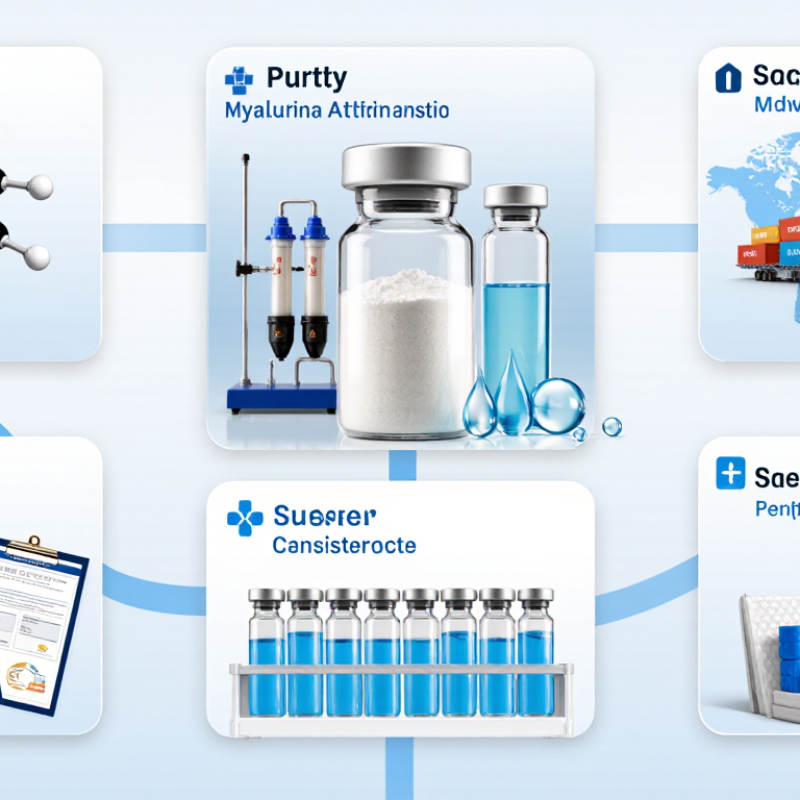
For global buyers, oligo hyaluronic acid should be defined by molecular weight, not by appearance or marketing language. The commonly purchased range is about 0.8–10 kDa. Lower molecular weights usually offer smaller chains and different skin interaction, while higher fractions may provide a distinct film-forming feel. The right range depends on the intended formulation.
Ask suppliers to state the molecular weight method clearly. Size-exclusion chromatography, viscosity testing, and other methods can produce different-looking results. A product listed as “5 kDa” may actually have a broad distribution around that value. Check the certificate of analysis for average molecular weight, distribution data, moisture, pH, and microbiological limits. Do not rely on one headline number.
Small details matter. Request a recent batch sample and compare its powder color, solubility, and solution clarity with the specification. A clear solution is useful, but it does not prove molecular accuracy. I have seen buyers focus on price before confirming testing conditions. That choice can create avoidable reformulation work. Batch consistency also deserves attention, especially when purchasing across borders. Ask whether the supplier retains samples and explains deviations. Documentation may look complete, yet an unclear test method remains a weakness. A neat number can still mislead. The best purchase decision connects the stated 0.8–10 kDa range with verified data and the actual product application.
When buying cosmetic-grade oligo hyaluronic acid (OHA), purity should be verified beyond a supplier’s marketing statement. Request a lot-specific certificate of analysis, HPLC or validated assay results, moisture, residual solvents, heavy metals, and molecular-weight distribution. OHA is highly water-soluble, so poor drying or packaging can encourage degradation. A clear powder is not proof of purity.
Microbial data deserve equal attention. ISO 17516:2014 sets a general limit of 10³ CFU/g or ml for many cosmetic products and requires the absence of specified pathogens in a tested sample. Ask whether testing covers bacteria, yeast, and mold, and whether the sample size matches the finished application. USP–NF General Chapter <85> describes bacterial endotoxin testing, but cosmetics do not have one universal endotoxin limit. Buyers should set a risk-based specification, especially for products used around the eyes or on damaged skin.
Test reports should identify the method, detection limit, sampling date, and laboratory accreditation. Endotoxin results reported only as “negative” are weak evidence. Ask for an actual value, such as EU/g, with the method stated. Also check container seals and storage history. I have seen documents that looked complete but omitted retest conditions. That gap matters. A supplier may provide excellent paperwork, yet one retained sample can still reveal inconsistent moisture or microbial recovery. Independent verification is not excessive; it is practical risk control.
Sources: ISO 17516:2014; USP–NF General Chapter <85>.
7 Oligo Hyaluronic Acid Buying Tips for Global Buyers
Match OHA concentration and pH with the finished formula, not the supplier’s headline specification. Oligo hyaluronic acid often supports lightweight hydration, but performance depends on molecular size, purity, and dosage. A practical starting range is 0.1% to 0.5% active OHA. Higher levels may increase tackiness or leave a tight after-feel. Always confirm whether the quoted concentration refers to active material or a diluted solution.
Skin surface pH commonly ranges from 4.5 to 5.5, according to reviews in the International Journal of Cosmetic Science. Therefore, facial leave-on products often perform well around pH 5.0 to 5.8. However, do not force every formula into that range. Cleansers, masks, and products containing acids may require different targets. Small changes matter. Check viscosity, clarity, odor, and hydration after pH adjustment.
Request stability data at the intended concentration and pH, including heat, freeze-thaw, and light exposure. The Cosmetic Ingredient Review safety assessment supports cosmetic use of hyaluronic acid ingredients under established conditions. ISO 17516 also sets microbiological limits, including 1,000 CFU/g or mL for many cosmetic products. That limit is not a substitute for preservation testing. A careful buyer should question vague “high purity” claims. I would also reconsider relying on one laboratory result, because batch variation can quietly change skin feel and delivery performance.
7 Oligo Hyaluronic Acid Buying Tips for Global Buyers
A reliable purchase starts with the supplier’s certificate of analysis, not a polished sales sheet. Check the batch number, test date, molecular weight distribution, concentration, pH, moisture, microbial limits, and endotoxin results. The testing method matters. A reported value without its method is difficult to compare. Ask whether an independent laboratory verified the results.
Traceability should follow the material from raw input to finished package. Request production dates, lot records, storage conditions, and transport details. The package label should match every document. Small mismatches can create large quality questions. I have seen buyers overlook this step when the sample looked excellent.
Minimum order quantity affects more than price. A large MOQ may increase storage exposure and slow product validation. Confirm sample quantities, retained samples, lead times, and change-notification procedures. Ask for regulatory documents relevant to each destination market, such as specifications, safety data, allergen statements, origin declarations, and manufacturing certifications. Documents should be current and applicable to the exact product grade.
Supplier audits can reveal details that PDFs cannot. Review quality-system controls, equipment cleaning, deviation handling, and complaint response times. Do not accept vague claims about global compliance. Requirements differ by intended use and jurisdiction. Even experienced buyers can miss an updated document or an unreported process change. That weakness deserves a documented check, not an assumption.
This checklist chart shows the suggested minimum evidence items to request when evaluating oligo hyaluronic acid suppliers. It covers lot quality, supply-chain traceability, order conditions, and international regulatory readiness. The values represent verification points, not supplier rankings or market-share data.
Oligo Hyaluronic Acid Buying Tips for Global Buyers
Before approving an oligo hyaluronic acid supplier, verify molecular-weight distribution, assay, moisture, microbial limits, and residual solvents. Ask for batch-specific certificates, not only a standard specification sheet. Stability deserves special attention. ICH Q1A(R2) uses long-term conditions of 25°C/60% RH or 30°C/65% RH, plus accelerated testing at 40°C/75% RH. These conditions are useful benchmarks, although they are not automatically required for every cosmetic ingredient. Request real-time and accelerated data, including appearance, viscosity, molecular weight, and microbiological results. Results that look too perfect deserve another question.
Packaging can quietly change product quality. Confirm whether the powder uses a sealed inner liner, moisture barrier, tamper evidence, and light protection. Check the fill weight against pallet dimensions and storage limits. A small packaging shortcut may create clumping during ocean transit. Lead time should include production, testing, document release, customs, and buffer stock. The World Bank’s 2023 Logistics Performance Index assessed 139 economies across customs, infrastructure, shipment quality, and timeliness; use these same factors when comparing shipping routes. Calculate total landed cost, not just the quoted kilogram price. Include freight, insurance, duties, brokerage, testing, warehousing, rejected batches, and currency movement. A lower offer can become expensive after arrival. One practical gap remains: many buyers compare suppliers using annual averages, while humidity and port delays are seasonal. Recheck the model quarterly.
| Buying Tip | Key Data Dimension | Practical Benchmark or Requirement | Documents and Tests to Request | Why It Matters for Global Buyers |
|---|---|---|---|---|
| 1. Define the Grade Specify molecular characteristics before comparing quotations. | Molecular weight, molecular-weight distribution, appearance, purity, and source. | Oligo hyaluronic acid products may be offered in different molecular-weight bands, commonly below 10 kDa. Do not compare products solely by the term “oligo”; require the numerical range, test method, and batch specification. | Certificate of Analysis (CoA), molecular-weight test report, chromatogram or analytical method, purity result, source statement, and non-animal-origin declaration where required. | A different molecular-weight profile can change solubility, viscosity, formulation behavior, regulatory positioning, and finished-product performance. |
| 2. Assess Stability Check whether the material can withstand international transit and storage. | Moisture, pH, temperature sensitivity, microbiological quality, and shelf life. | For dry powder, request moisture data and a clearly defined storage condition. A commercial shelf-life target of 12–24 months is common, but it must be supported by stability data. Avoid prolonged exposure to high heat, humidity, or extreme pH. | Real-time or accelerated stability data, moisture specification, microbial limits, recommended storage temperature, retest period, and temperature-excursion guidance. | Humidity and heat during ocean freight or customs delays can increase caking, reduce handling quality, and complicate batch release. |
| 3. Verify Packaging Match the packaging system to the product’s moisture sensitivity. | Primary container, moisture barrier, fill weight, tamper evidence, labeling, and pallet configuration. | A practical packaging configuration is a sealed food- or pharmaceutical-contact-compatible inner bag inside a moisture-barrier outer bag or foil laminate. Common commercial pack sizes include 100 g, 500 g, and 1 kg, subject to the agreed MOQ. | Packaging specification, pack-size tolerance, seal-integrity statement, product label, lot number, manufacture date, expiry or retest date, and packing photographs before shipment. | Weak moisture protection can cause product loss, while unclear lot labeling can delay customs clearance and incoming quality control. |
| 4. Confirm Quality Controls Evaluate consistency rather than relying on a single sample. | Batch-to-batch consistency, purity, microbial limits, residual solvents, heavy metals, and endotoxin where applicable. | Set acceptance criteria before purchase. Typical qualification testing may include identity, assay or purity, molecular weight, loss on drying or moisture, total aerobic microbial count, yeast and mold, heavy metals, and endotoxin when the intended application requires it. | Three-batch CoA comparison, specification sheet, method validation or method reference, audit questionnaire, change-control policy, and retention-sample policy. | A low unit price is not economical if inconsistent batches create rejected shipments, reformulation work, or additional testing costs. |
| 5. Calculate Lead Time Separate ready-stock timing from production timing. | Sample preparation, quality release, production schedule, export documentation, transit, and customs clearance. | Indicative planning ranges are 1–3 weeks for available stock, 4–8 weeks for made-to-order material, and 8–12 weeks for customized specifications or new qualification batches. Confirm the timeline in writing for each purchase order. | Production schedule, promised ship date, quality-release date, estimated transit time, Incoterm, booking plan, export documents, and contingency plan for delays. | The material may arrive after the production window even when the supplier’s manufacturing lead time appears acceptable. |
| 6. Compare Total Landed Cost Look beyond the quoted price per kilogram. | Product price, freight, insurance, duty, broker fees, testing, local delivery, warehousing, and potential loss. | Use this formula: Total Landed Cost = Product Cost + Freight + Insurance + Import Duty + Customs/Brokerage + Local Delivery + Inspection/Testing + Storage. Illustrative example for a 1 kg shipment: $180 product cost + $20 freight + $2 insurance + $10.10 duty at 5% of the $202.00 customs value + $8 brokerage + $12 local delivery = $232.10 before tax. | Commercial invoice, packing list, HS-code proposal, freight quotation, country-of-origin document, duty estimate, customs-broker quotation, and tax treatment. | A lower ex-works price can become more expensive after freight, import charges, testing, and small-shipment handling fees are included. |
| 7. Check Regulatory Readiness Confirm that the documentation matches the destination market and intended use. | Intended application, country-specific requirements, claims, traceability, and change notification. | Clarify whether the material is intended for cosmetic, personal-care, food, research, or another application. Requirements for microbiological quality, residual substances, animal-origin status, and labeling vary by jurisdiction and should be confirmed before shipment. | SDS, CoA, technical data sheet, allergen statement, GMO statement where relevant, animal-origin declaration, country of origin, manufacturing-flow summary, regulatory questionnaire, and change-control commitment. | Complete documentation reduces customs questions, shortens internal approval time, and helps prevent an otherwise conforming batch from being unusable in the destination market. |
Contact our team with questions, product inquiries or challenge us to engineer a solution for you.
Tel: +1 716 433 6764
Fax: +1 716 433 2850
Email: sale@ashymed.com
VanDeMark Chemical Inc.
One North Transit Road
Lockport, NY 14094 USA