What is a Complex Chemical and How Does It Impact Our World?
Complex chemicals are fundamental to our daily lives. They exist in various forms, influencing everything from the air we breathe to the food we eat. Understanding complex chemicals can help us appreciate their roles in nature and industry.
These substances are more than just intricate formulas; they hold the key to advancements in science and technology. For instance, they are crucial in creating pharmaceuticals, plastics, and agricultural products. Yet, their impact is not always positive. Some complex chemicals can harm ecosystems and human health. This duality invites careful consideration.
By exploring complex chemicals, we can uncover their benefits and risks. It requires a nuanced approach, considering both their essential functions and potential dangers. As we delve into their complexities, we confront our reliance on these substances. A deeper understanding may spark critical discussions about safety and sustainability.
What Defines a Complex Chemical in Modern Chemistry?
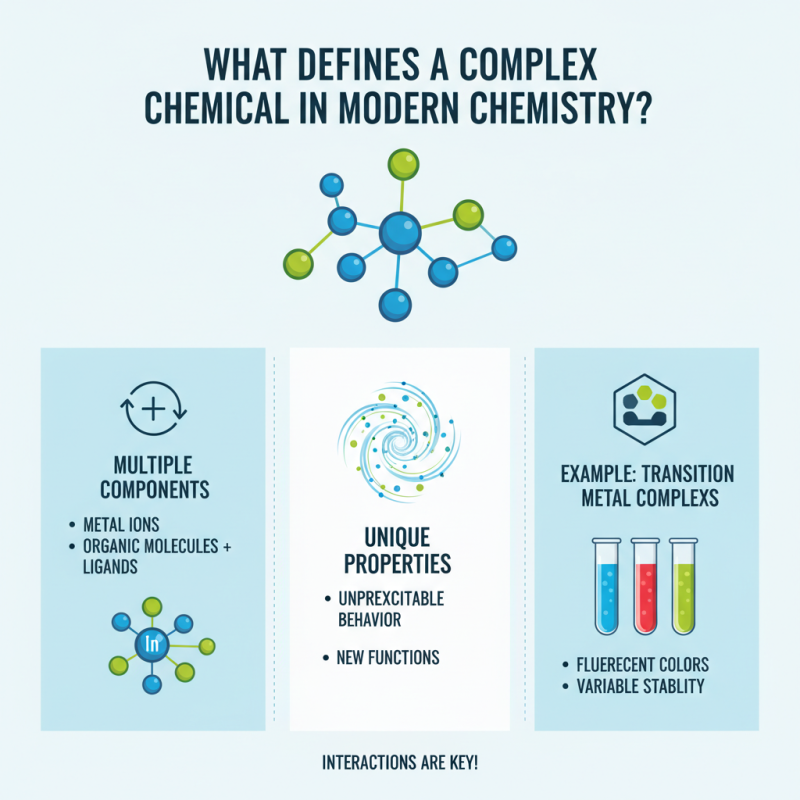
In modern chemistry, a complex chemical is a compound formed from multiple atoms bonded together. These compounds can include metal ions, organic molecules, and different ligands. The interactions between these components create properties that are unique and often unpredictable. For instance, transition metal complexes can show vibrant colors and varying degrees of stability depending on their ligands.
Complex chemicals play important roles in our daily lives. They are used in pharmaceuticals, agriculture, and even environmental cleanup. Many drugs target complex systems within the body, showcasing how these chemicals can dictate cellular functions. Moreover, complex chemicals facilitate processes in industrial settings, transforming raw materials into useful products.
However, the study of complex chemicals isn't without challenges. Their behaviors can be difficult to predict and manipulate. For instance, the same complex might behave differently under varying conditions. Understanding these intricate behaviors requires continuous research and experimentation. It opens up room for debate on how we can safely harness these compounds for societal benefits while minimizing potential risks.
Key Characteristics and Classification of Complex Chemicals
Complex chemicals are fascinating structures with unique properties. They are formed by combining various simple chemicals. This mixture creates new functions and behaviors. Understanding complex chemicals helps scientists design medicines and materials. Their intricate nature is essential in many fields.
Key characteristics include their component diversity. This complexity can lead to unexpected reactions. Some complex chemicals are stable, while others are not. Stability depends on their structure and environmental conditions. Their classification can be based on various factors. Categories may include organic versus inorganic, or natural versus synthetic. Each type has specific applications and implications.
Despite the deep knowledge in this area, understanding complex chemicals is not perfect. Research is ongoing to uncover all their properties. Misinterpretations can occur due to their intricate interactions. Collaboration across disciplines is crucial for better insights. For example, chemists and biologists often need to share knowledge. This teamwork enhances the understanding of complex chemicals and their impact. Such exploration continues to reveal the intricacies of our world.
The Role of Complex Chemicals in Industrial Applications
Complex chemicals play a crucial role in various industrial applications. They are compounds made up of multiple elements and often exhibit unique properties. Industries leverage these chemicals for catalytic processes, synthesis, and more. For instance, catalysts speed up chemical reactions, making them more efficient. This efficiency can significantly lower production costs in industries like pharmaceuticals.
Moreover, complex chemicals contribute to product innovation. In materials science, polymers and composites enhance durability and performance. These materials are essential in manufacturing sectors ranging from automotive to aerospace. However, the impact of complex chemicals is not solely positive. Safety concerns arise due to their handling and potential environmental effects. Industries must evaluate these risks carefully.
Understanding the balance between benefits and challenges is vital. Continuous research is necessary to improve safety protocols. The dialogue surrounding complex chemicals should remain open and proactive. This ensures that while we harness their potential, we also protect our environment and human health.
Impact of Complex Chemicals in Industrial Applications
This bar chart illustrates the utilization of various complex chemicals across different industrial applications, showcasing their significant roles in enhancing production efficiency and product quality.
Environmental Impact of Complex Chemicals on Ecosystems
Complex chemicals play a significant role in our ecosystems. They can be found in everyday products, from plastics to detergents. When these chemicals enter the environment, they can cause harmful changes. For example, some complex chemicals disrupt hormone systems in wildlife, leading to reproductive issues. Aquatic life is especially vulnerable. Chemicals can accumulate in water bodies, impacting fish and other organisms.
Understanding the environmental impact of these chemicals is essential. Some substances are persistent, meaning they do not break down easily. This can lead to bioaccumulation in the food chain. Animals at the top levels often suffer the most. Ecosystems depend on balance, and complex chemicals can disrupt this balance severely.
Efforts to regulate these chemicals are ongoing, yet challenges remain. Many industries still rely on them for production. Finding safer alternatives is a step toward protecting our environments. Public awareness and advocacy are crucial for change. More research is needed to comprehend fully how these chemicals affect our ecosystems. Solutions are not straightforward, requiring a collective effort from scientists, policymakers, and the public.
What is a Complex Chemical and How Does It Impact Our World? - Environmental Impact of Complex Chemicals on Ecosystems
| Chemical Name |
Category |
Ecosystem Impact |
Source |
Mitigation Strategies |
| Polychlorinated Biphenyls (PCBs) |
Persistent Organic Pollutant |
Bioaccumulation in food webs, endocrine disruption in wildlife |
Industrial Waste |
Regulation, cleanup of contaminated sites |
| Heavy Metals (Lead, Mercury) |
Heavy Metals |
Toxicity to aquatic life, neurological damage |
Mining, industrial discharges |
Source control, phytoremediation |
| Phthalates |
Plasticizers |
Hormonal disruption, effects on reproduction in wildlife |
Plastic production |
Alternatives, regulatory limits |
| Nutrients (Nitrogen, Phosphorus) |
Fertilizers |
Eutrophication of water bodies, harmful algal blooms |
Agricultural runoff |
Buffer strips, nutrient management |
Future Trends in Complex Chemical Research and Innovation
The field of complex chemical research is rapidly evolving. Scientists are now focusing on multi-component systems that exhibit intricate behaviors. These complex chemicals are not just about composition; they involve interactions at multiple levels. Innovations in this area can lead to breakthroughs in medicine, materials science, and energy solutions.
Research is exploring how these complex chemicals can improve everyday products. For instance, new catalysts can make chemical processes more efficient. This could lower costs and reduce waste. However, challenges remain. The manipulation of these compounds often leads to unpredictable reactions. Understanding these complexities requires advanced knowledge and expertise.
The future trends in this field emphasize sustainability and efficiency. Researchers are looking for ways to create environmentally friendly reactions. This shift is essential for addressing global challenges like climate change. As innovations continue, the balance between efficiency and safety must be considered. Complex chemicals hold promise, but their potential also demands careful scrutiny.